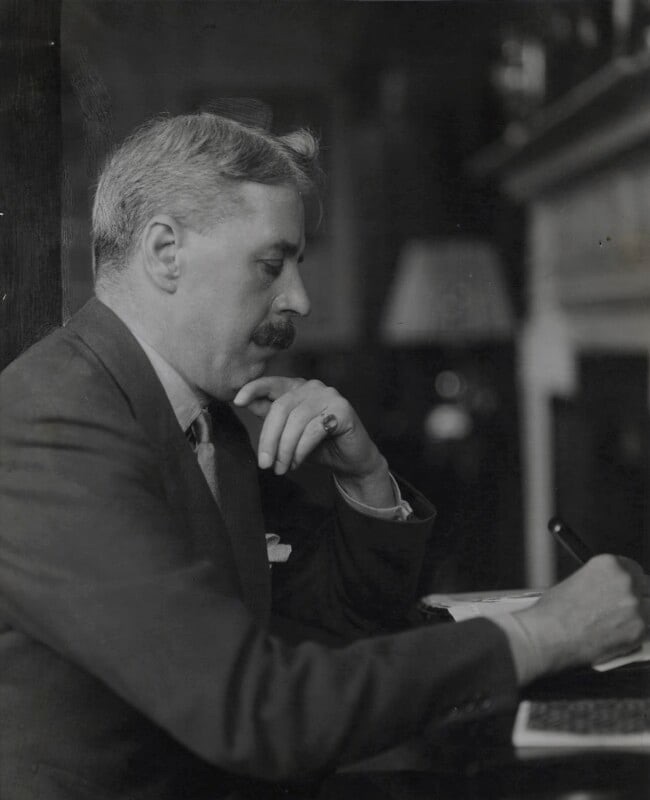
Welcome to Beyond the Five Towns, a place to explore the works and world of author Arnold Bennett (1867-1931).
Why Arnold Bennett?
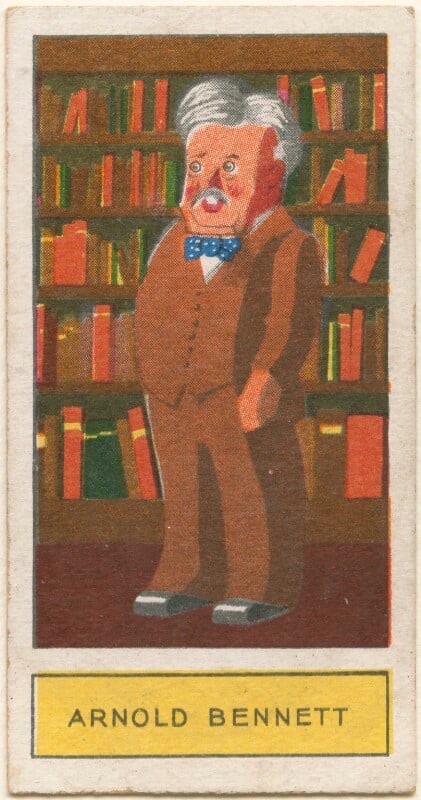
Arnold Bennett was one of the most prolific and popular writers of his day. He wrote novels both comic (The Card, 1911) and tragic (The Old Wives’ Tale, 1908), as well as supernatural stories (The Ghost, 1907) and detective fiction (The Loot of Cities, 1905). His short stories were published in the most popular magazines of the period including The Yellow Book and The Windsor Magazine. His plays were performed on London’s West End. He wrote newspaper columns and essays about anything that interested him: truffles and tailoring, friendship and football, eggs and Egyptology, Balzac and bicarbonate of soda. He was a pioneer of ‘self-help’ books, and his How to Live on Twenty-Four Hours a Day (first published in book form in 1908) is still read and recommended today.1 After his death, he was even included in a set of collectable cigarette cards alongside the actors Douglas Fairbanks, Charlie Chaplin and Harold Lloyd and the boxer Jack Dempsey.2 He deserves to be more widely read.
The ‘Five Towns’

Many of Bennett’s novels and short stories are set in the ‘Five Towns’, a fictional version of the area he was born and grew up in. Bennett’s towns were based on the ‘Six Towns’ of Stoke-on-Trent: Hanley (the place of his birth), Burslem, Fenton, Longton, Stoke-upon-Trent and Tunstall. When it came to writing about the area, Bennett changed the six towns to five and gave them new names:
Five contiguous towns — Turnhill, Bursley, Hanbridge, Knype, and Longshaw — united by a single winding thoroughfare some eight miles in length, have inundated the valley like a succession of great lakes… Nothing could be more prosaic than the huddled, red-brown streets; nothing more seemingly remote from romance. Yet be it said that romance is even here — the romance which, for those who have an eye to perceive it, ever dwells amid the seats of industrial manufacture, softening the coarseness, transfiguring the squalor, of these almighty alchemical operations.3
Bennett seems to have had ambivalent feelings about the place where he spent his earliest years. In 1927, many years after he first left, he writes in his journal of travelling through the area:
I took the 12.5 back to London, which went through the Potteries. The sight of this district gave me a shudder.4
Despite any ambivalence he may have felt, Bennett made the ‘Five Towns’ the setting for some of his most celebrated novels including The Card (1911) and his ‘masterpieces’ The Old Wives’ Tale (1908) and the Clayhanger trilogy (1910-1916).5 But, as we will see in future posts, both Bennett’s life and his literary worlds extended far beyond the ‘Five Towns’.
What you can expect here

Beyond the Five Towns aims to celebrate Bennett’s life and literature, to introduce him to new readers and to explore the social history of the times he lived in. It isn’t just for Bennett fans; it’s for anyone interested in literature, writing and history.
Although I’ve named this blog Beyond the Five Towns, some discussion of Bennett’s ‘Five Towns’ is inevitable. But Arnold Bennett’s works and world extend far beyond the fictional places of the ‘Five Towns’. In future posts, we’ll look at Bennett’s short stories, screenplays, journals, ‘Pocket Philosophies’ and more. We’ll examine the lives and works of his friends and contemporaries, and we’ll explore aspects of social history captured in his writing.

- Beth Blum, The Self Help Compulsion: Searching for Advice in Modern Literature (Columbia University Press, 2020), 134. ↩︎
- “Godfrey Phillips,” National Portrait Gallery, London, accessed 7 January 2026, https://www.npg.org.uk/collections/search/person/mp141927/godfrey-phillips ↩︎
- Arnold Bennett, Anna of the Five Towns (Penguin Books, 1980; first published 1902), 25. ↩︎
- Arnold Bennett, The Journal of Arnold Bennett (The Literary Guild, 1933), 20 October 1927, 983. ↩︎
- John Carey, The Intellectuals and the Masses: Pride and Prejudice Among the Literary Intelligentsia, 1880-1939 (Faber & Faber, 1992), 163. ↩︎
 Beyond the Five Towns
Leave a comment